AI-Search Optimization: The Complete Guide
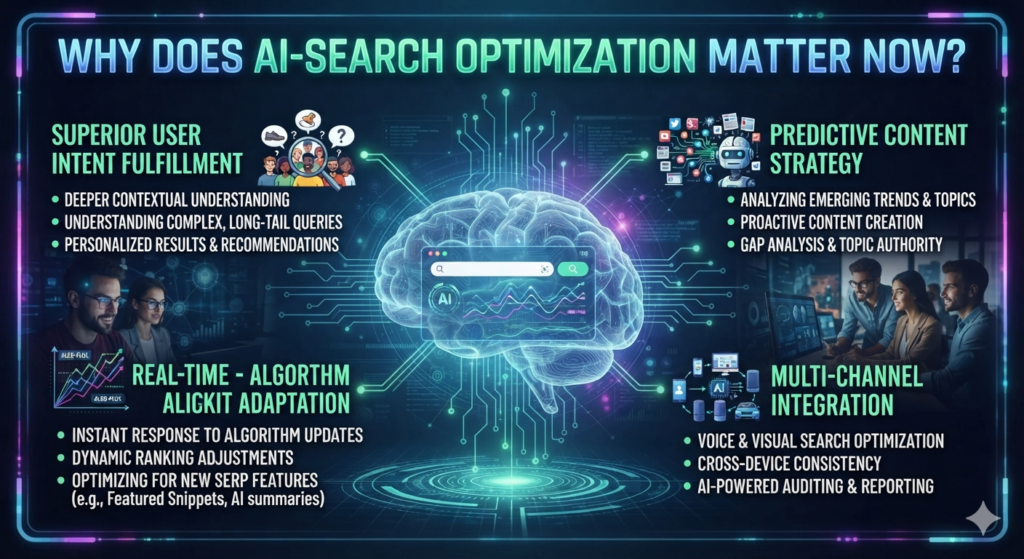
AI-search optimization matters now because half of consumers already use AI-powered search, and it could influence $750B in revenue by 2028. Gartner predicts a 25% drop in traditional search volume by 2026 as chatbots and agents take over discovery. AI engines favor fresh, authoritative, extractable content — which changes how brands write, structure, and promote information. Optimizing only for clicks means missing the new front door to the internet.
Key stats:
- 50% of consumers already use AI-powered search
- $750B in revenue potentially impacted by 2028
- 25% projected drop in traditional search volume by 2026
What’s the difference between SEO, AEO, and GEO?
SEO ranks you in organic results, AEO gets you featured in direct answers and snippets, and GEO gets you cited or recommended by LLMs like ChatGPT and Perplexity. In practice, all three run as one combined strategy: rank well, answer clearly, and earn citations.
| Discipline | Primary Goal | Key Metric |
|---|---|---|
| SEO (Search Engine Optimization) | Rank in organic results | Clicks, rankings, impressions |
| AEO (Answer Engine Optimization) | Appear in direct answers & snippets | Featured snippets, AI Overview citations |
| GEO (Generative Engine Optimization) | Be cited/recommended by LLMs | Brand mentions in ChatGPT, Perplexity, Gemini answers |
What are the core principles of AI-search optimization?
The five core principles are: answer-first structure, extractable formatting, verifiable facts, strong entity/brand signals, and technical accessibility for AI crawlers. Each principle addresses a different way AI engines evaluate, extract, and trust content before citing it.
1. How should you structure content so AI can extract it?
Put a complete 40–60 word answer in the first sentence under every heading, so each section can stand alone without needing the rest of the article. AI models scan for quick validation, not full-page context.
Use this pattern on every key page:
- H2 = a real question (e.g., “What is AI-search optimization?”)
- 40–60 word direct answer
- Expanded explanation (why it’s true, when it applies)
- Structured examples, steps, or a table
- Short FAQ for long-tail coverage
2. What makes content extractable to AI engines?
Extractable content uses clear self-contained definitions (50–100 words), numbered lists, comparison tables, and plain conversational headings that mirror real queries. Write in semantic chunks — one idea per paragraph, 40–60 words each — so an engine can lift a single chunk cleanly.
AI engines specifically prefer:
- Clear definitions and summaries (50–100 words)
- Numbered lists, comparison tables, and “how-to” steps
- Plain headings that mirror conversational queries (e.g., “How do I optimize for AI Overviews?”)
3. How do you ground content in verifiable facts?
Ground content by citing data and named sources, keeping facts consistent across your site and third-party mentions, and refreshing cornerstone content at least every 6 months. Embed 3–5 external authority citations per article to boost AI visibility.
4. How do you strengthen entity and brand signals?
Strengthen entity signals by implementing Organization, Person, and Product schema, claiming your Google Business Profile, and earning mentions across trusted sites, podcasts, Reddit, LinkedIn, and review platforms. Brand mentions increasingly matter more than raw backlink counts for AI citations.
5. How do you make a site technically accessible to AI crawlers?
Make your site accessible by allowing AI crawlers (GPTBot, PerplexityBot) in robots.txt, using server-side rendering, adding an llms.txt file, and implementing structured data. If AI bots can’t read your content, they can’t cite it.
Technical checklist:
- Allow AI crawlers in robots.txt
- Server-side render content (don’t rely on JS execution)
- Add an llms.txt file summarizing your site — shown to produce 2.3× higher AI citation rates
- Implement structured data: Article, FAQPage, HowTo, Product, BreadcrumbList, Organization, Person
What does a 90-day AI-search optimization plan look like?
A 90-day plan moves through four phases: audit (days 1–15), content restructuring (days 16–45), technical GEO setup (days 46–75), and citation building plus measurement (days 76–90).
Days 1–15: Audit and diagnose
- Identify 5–10 core topics you want to be known for
- Map top questions, comparisons, and “best/how/why” queries per topic
- Check current visibility in: Google Search Console (rankings, impressions), AI Overviews for your top 50 keywords, and representative prompts in ChatGPT, Perplexity, and Gemini
Days 16–45: Restructure and enrich content
- Rewrite H2/H3s as questions with a 40–60 word answer block directly below
- Add FAQ sections using FAQPage schema
- Insert comparison tables and numbered “how-to” lists where relevant
- Add unique data: original research, case studies, or proprietary benchmarks
- Include a short “How we evaluated” or methodology section to signal rigor
Days 46–75: Technical GEO setup
- Deploy stacked JSON-LD schema (Article + FAQPage + Organization + Person minimum)
- Create and publish an llms.txt summarizing key pages and topics
- Confirm AI bots are allowed in robots.txt; test with AI user-agents
- Ensure key pages are server-side rendered and fast on mobile
Days 76–90: Build citation networks and measure
- Pitch data-driven insights to industry blogs, newsletters, and podcasts
- Encourage discussions and mentions on Reddit, LinkedIn, and relevant communities
- Track AI citation frequency, generative referral traffic, and assisted conversions influenced by AI channels
What should be on every AI-search optimization checklist?
Use a 9-point checklist on every cornerstone page: question-based headings, a 40–60 word direct answer under each one, self-contained definitions, structured formatting, external citations, FAQ schema, entity schema, fresh data, and AI crawler access.
- [ ] H1 clearly states the topic; H2/H3 are real questions
- [ ] First sentence under each heading answers the question in 40–60 words
- [ ] Definitions and summaries are concise and self-contained
- [ ] Content uses bullet points, numbered lists, and at least one table where useful
- [ ] 3–5 external authority citations included
- [ ] FAQ block with FAQPage schema added
- [ ] Article, Organization, and Person schema implemented
- [ ] Content updated in the last 6 months with fresh data
- [ ] Site allows AI crawlers and includes llms.txt
What mistakes hurt AI-search visibility?
The most common mistakes are: wall-of-text articles with no Q&A structure, opinion-only content without data or sources, blocking AI crawlers or relying on client-side rendering, optimizing only for Google, and never updating content.
- Wall-of-text articles with no clear Q&A structure — AI can’t easily extract answers
- Vague, opinion-only content without data, sources, or named experts
- Blocking AI crawlers or relying solely on client-side rendering
- Optimizing only for Google and ignoring ChatGPT, Perplexity, and Gemini behaviors
- Never updating content — un-updated pages lose citations at up to 3× the normal rate
How do you measure success in AI search?
Measure success with five signals: AI Overview presence, citation rate, generative traffic, assisted conversions, and share-of-model versus competitors. Move beyond rankings alone — these signals show whether AI engines are actually surfacing and trusting your content.
| Metric | What it tells you |
|---|---|
| AI Overview presence | Whether you appear for priority keywords |
| Citation rate | How often your brand/page is mentioned in AI answers |
| Generative traffic | Referral traffic from AI surfaces |
| Assisted conversions | Deals influenced by AI-referred awareness |
| Share-of-model | Your brand’s visibility vs. competitors inside specific AI tools |
Use these signals to refine topics, refresh content, and double down on formats that get cited.
Bottom line: does AI-search optimization replace SEO?
No — AI-search optimization extends SEO rather than replacing it. Strong rankings still matter, but content also needs to be easy to extract, hard to ignore, and impossible to misquote. Combining answer-first structure, solid data, schema markup, and off-site brand signals positions a brand to be found — and cited — across both traditional and AI-driven search.